Understanding the WCAG 2.2 Internationalization Updates
Date Published: Jul 11, 2026
Date Modified: Jul 11, 2026
The internet is multilingual, yet accessibility guidance has traditionally been interpreted through the lens of Latin-based languages such as English. As organizations expand globally, ensuring that accessibility requirements apply equally to Arabic, Chinese, Japanese, Hindi, Korean and other writing systems becomes increasingly important.
To improve clarity, the W3C introduced updates to WCAG 2.2 in October 2023, specifically addressing internationalization. While these changes do not introduce new success criteria, they clarify how accessibility requirements should be interpreted across different languages and writing systems.
Why Was This Update Needed?
Many accessibility requirements were originally written using examples based on English text. However, not every language behaves the same way.
- Chinese and Japanese often don't use spaces between words.
- Arabic is written from right to left.
- Some Indic languages combine characters into complex glyphs.
- Letter spacing, word spacing and line breaking vary significantly between writing systems.
Without clarification, developers could mistakenly assume that accessibility requirements were designed only for English-language content.
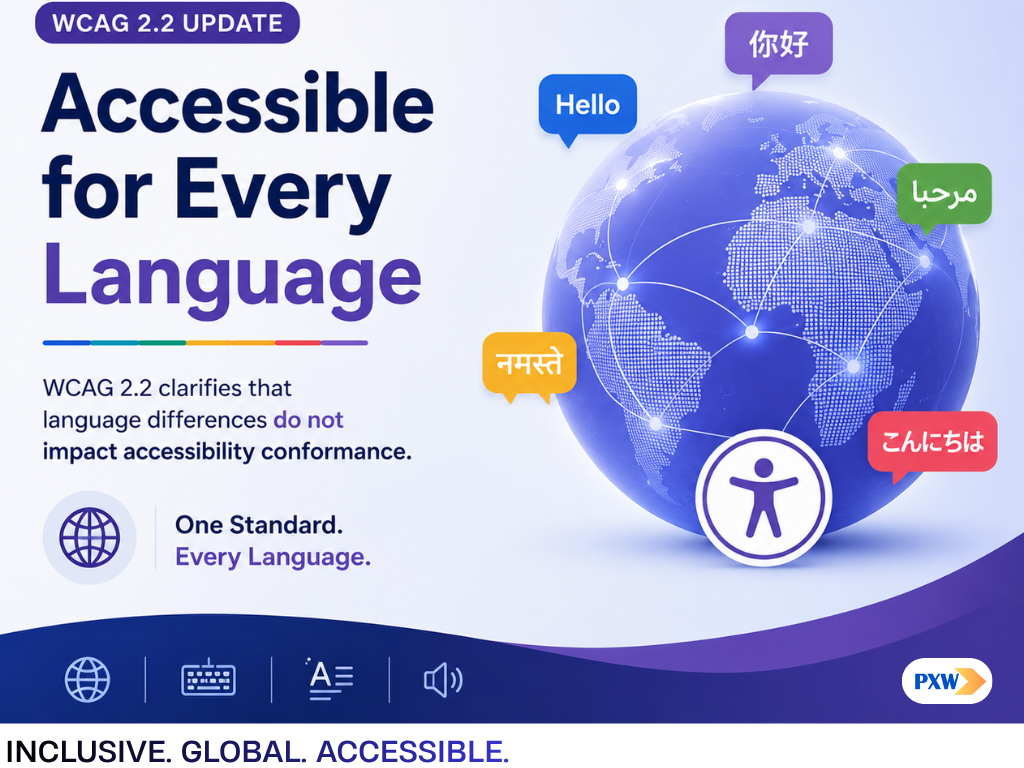
The W3C addressed this by explicitly stating that language differences do not affect WCAG conformance.
What Changed in WCAG 2.2?
In October 2023, explanatory notes were added to two Success Criteria:
-
1.4.8 Visual Presentation (Level AAA)
This criterion provides recommendations for improving readability, including line spacing, paragraph spacing and line length.
The new note explains that these recommendations should be interpreted appropriately for different writing systems. A language with different typography should not be considered non-conformant simply because its presentation differs from English.
-
1.4.13 Text Spacing (Level AA)
This criterion requires that users can adjust text spacing without losing content or functionality.
The update clarifies that languages which naturally use different spacing conventions still conform to WCAG. The requirement focuses on preserving usability rather than enforcing English typography rules.
What Does Internationalization Mean?
Internationalization (often abbreviated as i18n) refers to designing software and digital content so it can adapt to different languages, cultures and regions without requiring major redesign.
Accessibility and internationalization work hand in hand.
An accessible website should remain usable whether its content is displayed in English, Arabic, Japanese, French or Hindi.
Examples
Example 1 – Japanese
Japanese text often appears without spaces between words. Applying English-based spacing expectations would produce awkward formatting and could reduce readability.
WCAG now explicitly acknowledges these language-specific differences.
Example 2 – Arabic
Arabic uses right-to-left text direction and connected letterforms. Spacing behaviour differs significantly from English, yet users must still be able to read content comfortably and interact with it successfully.
Example 3 – Hindi
Hindi uses the Devanagari script where multiple characters combine into complex glyphs. Accessibility testing should focus on preserving readability and functionality rather than applying assumptions based on Latin typography.
What This Means for Developers
- Don't assume English typography applies globally.
- Test multilingual websites using real translated content rather than placeholder text.
- Verify text spacing after localization.
- Support both left-to-right (LTR) and right-to-left (RTL) layouts where required.
- Ensure responsive layouts remain usable across different scripts.
- Include multilingual accessibility testing in your QA process.
What This Means for Accessibility Auditors
Accessibility audits should consider the language being evaluated.
Auditors should avoid flagging issues simply because a language behaves differently from English. Instead, evaluations should determine whether users can successfully perceive, understand and interact with the content in its native writing system.
Why This Matters for Global Businesses
Organizations serving international audiences increasingly publish content in multiple languages. These updates reinforce that accessibility is not language-specific but user-focused.
Whether your audience reads English, Arabic, Japanese or Hindi, accessibility should provide an equivalent experience for every user.
Conclusion
The October 2023 updates to WCAG 2.2 did not introduce new accessibility requirements. Instead, they clarified an important principle:
Language differences do not affect WCAG conformance.
This seemingly small clarification has a significant global impact. It reinforces that accessibility standards are designed to support users across every language and writing system—not just English.
As digital products continue to reach international audiences, combining accessibility with thoughtful internationalization will help create experiences that are truly inclusive for everyone.