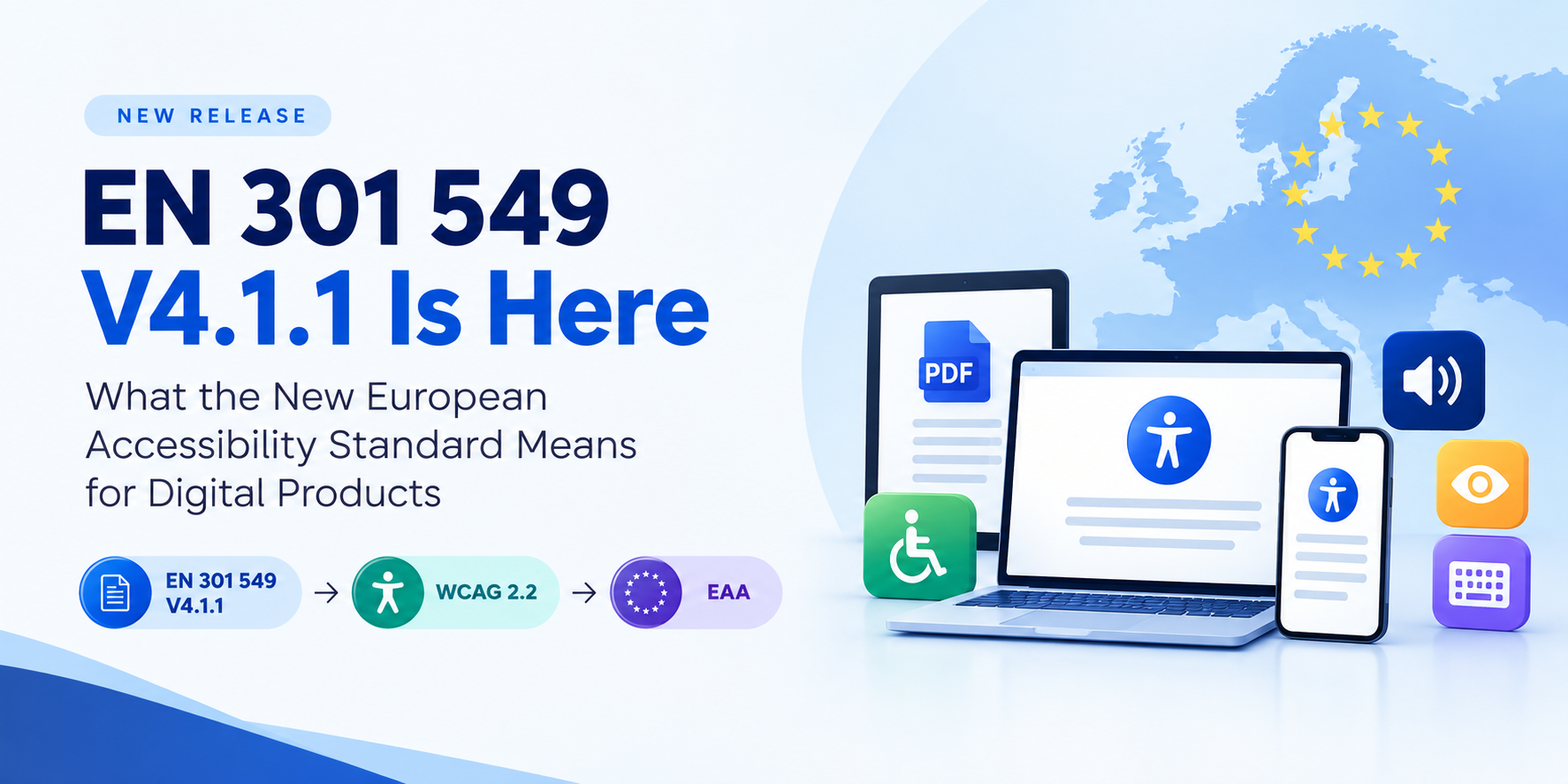
EN 301 549 V4.1.1 Is Here: What the New European Accessibility Standard Means for Digital Products
Date Published: Sep 22, 2026
Date Modified: Sep 22, 2026
Europe’s digital accessibility landscape has entered its next phase.
In September 2026, ETSI published EN 301 549 V4.1.1 - Accessibility requirements for ICT products and services, the latest edition of the European accessibility standard covering information and communication technology products and services.
The update is important for accessibility, product, compliance, procurement and engineering teams because it moves the standard’s web accessibility requirements from WCAG 2.1 to WCAG 2.2, while also introducing broader changes covering user preferences, real-time communication, digital documents, software and the relationship between EN 301 549 and the European Accessibility Act (EAA).
But there is an important distinction: publication of V4.1.1 does not yet mean that V4.1.1 has become the legally cited harmonised standard for the EAA.
That makes this release both a technical milestone and a preparation point for organisations operating in or serving the European market.
What is EN 301 549?
EN 301 549 is the European standard that defines accessibility requirements for ICT products and services. Its scope goes considerably beyond websites.
It can cover technologies such as:
- Websites and web applications
- Mobile and desktop software
- Digital documents
- Hardware and ICT devices
- Real-time communication systems
- Video and multimedia technologies
- Electronic documents and supporting information
The standard combines technical accessibility requirements with functional performance criteria, helping organisations evaluate whether people with different disabilities can locate, identify and operate technology.
This is why EN 301 549 should not be viewed simply as another name for WCAG.
WCAG is one important component of EN 301 549. EN 301 549 is the broader ICT accessibility standard.
What changed in V4.1.1?
The headline change is straightforward:
EN 301 549 V4.1.1 brings WCAG 2.2 into the latest European ICT accessibility standard.
For web content, the requirements now reference WCAG 2.2. The updated provisions are also reflected in the relevant requirements for non-web documents and software.
But the release is broader than the WCAG update.
Key areas of change include:
- Adoption of WCAG 2.2 requirements
- Six additional WCAG 2.2 Level A/AA success criteria
- Removal of the obsolete WCAG 4.1.1 Parsing requirement
- Reworked requirements relating to user preferences
- Updated requirements for real-time communication and real-time text
- New mapping to the European Accessibility Act through Annex ZB
- A new clause A.2 supporting evaluation of specific ICT products and services against the essential requirements of Directive (EU) 2019/882
ETSI specifically notes the addition of Annex ZB and clause A.2 in the new standard.
One requirement disappears: WCAG 4.1.1 Parsing
There is also an important removal.
WCAG 4.1.1 Parsing is no longer a success criterion in WCAG 2.2.
EN 301 549 V4.1.1 reflects this change by marking the corresponding requirement as Void.
This does not mean that code quality, semantic structure or compatibility no longer matter.
Other accessibility requirements continue to address issues such as names, roles, values, states and relationships. The change simply means that teams should update their testing methodologies rather than carrying obsolete WCAG 2.1 checks forward indefinitely.
It is not only about WCAG
This is perhaps the most important point about the new release.
An EN 301 549 assessment should not automatically become:
“Run a WCAG 2.2 scan and call it EN 301 549 compliance.”
EN 301 549 has requirements that extend beyond the WCAG success criteria.
The standard covers areas such as:
- Functional performance
- Closed functionality
- Accessibility features
- Biometrics
- Hardware
- Real-time communication
- Real-time text
- Video capabilities
- Non-web documents
- Non-web software
- Support and product information
- User preferences
Its structure is designed to address different forms of ICT rather than treating every digital product as a website.
User preferences receive greater attention
Another notable area in V4.1.1 is the treatment of accessibility preferences.
The updated requirements address situations where digital content or documents interact with documented platform accessibility features and user preferences. For example, the standard includes checks around whether non-web documents explicitly override user preferences and whether such overrides are justified by fundamental changes to the information or functionality.
This represents an important shift in thinking:
Accessibility is not only about providing accessibility features. Products also need to respect accessibility settings that users have already configured.
What does this mean for PDFs and digital documents?
Organisations should not limit their transition planning to websites.
EN 301 549 contains dedicated requirements for non-web documents, and the updated WCAG 2.2 requirements influence the relevant document accessibility provisions.
That means accessibility programmes should review assets such as:
- PDFs
- Word documents
- PowerPoint presentations
- Digital forms
- Reports
- Guides and manuals
- Customer-facing documentation
For organisations producing large volumes of digital content, this can become a significant part of accessibility governance.
What should organisations do now?
There is no need to throw away existing accessibility work. Instead, organisations can treat V4.1.1 as a transition roadmap.
1. Identify your current baseline
Determine whether your existing accessibility programme is based on:
- WCAG 2.1
- WCAG 2.2
- EN 301 549 V3.2.1
- Another regulatory or contractual requirement
2. Run a WCAG 2.1 → 2.2 gap assessment
Pay particular attention to the six new Level A/AA success criteria.
3. Review your EN 301 549 scope
Do not assess only the website if your product ecosystem also includes:
- Mobile applications
- Desktop software
- PDFs and documents
- Hardware
- Video
- Real-time communication
- Customer support systems
4. Update accessibility testing checklists
Testing teams should update manual and automated test procedures to reflect WCAG 2.2 and the relevant EN 301 549 clauses.
This is particularly important for focus visibility, target size, dragging interactions, authentication and multi-step forms.
5. Review procurement requirements
If your organisation purchases software, SaaS platforms, digital services or ICT products, update accessibility requirements in vendor questionnaires, contracts and evaluation criteria.
Ask vendors which version of EN 301 549 they are testing against and request evidence rather than relying only on a general accessibility statement.
6. Prepare your documentation
Accessibility conformance documentation should clearly identify:
- The standard and version used
- The scope of the assessment
- Products and services assessed
- Testing methods
- Assistive technologies used
- Known limitations
- Remediation status
- Relevant legal or contractual requirements
The bigger shift: from accessibility testing to accessibility governance
EN 301 549 V4.1.1 is significant because it reinforces a broader idea:
Digital accessibility is becoming a product lifecycle responsibility.
It touches design, development, content, procurement, quality assurance, documentation, user support and compliance.
A one-time accessibility audit can identify problems. A mature accessibility programme ensures those problems do not continuously return.
That requires accessibility to be incorporated into:
- Design systems
- Development standards
- QA processes
- Content workflows
- Procurement
- Vendor management
- Release management
- Remediation tracking
- Accessibility statements
- Ongoing monitoring
What V4.1.1 means for accessibility teams
For accessibility professionals, this release is an opportunity to revisit how assessments are performed.
A modern EN 301 549 assessment should combine:
- Automated testing for scalable detection of machine-detectable issues
- Manual testing for interaction, behaviour and context
- Keyboard testing across critical journeys
- Screen reader testing using relevant assistive technologies
- Mobile accessibility testing where applicable
- Document accessibility testing for PDFs and other digital documents
- User journey testing across important tasks
- Remediation validation after fixes
The objective is not simply to produce a list of WCAG failures.
The objective is to understand whether the actual ICT product or service can be successfully used by people with different accessibility needs.
EN 301 549 V4.1.1: The practical takeaway
The release can be summarised in one sentence:
EN 301 549 V4.1.1 brings Europe’s ICT accessibility framework forward to WCAG 2.2 while expanding the conversation beyond web pages to the wider digital product ecosystem.
For organisations, this is the right time to prepare rather than wait for the legal transition to force the conversation.
- Review your current accessibility baseline.
- Identify the WCAG 2.2 gaps.
- Revisit your EN 301 549 scope.
- Update your testing methodology.
- Review your documents, software, procurement processes and accessibility governance.
And most importantly, make accessibility part of the product lifecycle rather than a final compliance checkpoint.
Final thought
Accessibility standards evolve because technology evolves.
The release of EN 301 549 V4.1.1 is therefore not simply another version number to add to a compliance checklist. It is a signal that European digital accessibility is moving toward a broader, more integrated approach covering products, services, content, software and the way users interact with technology.
For organisations already working toward WCAG 2.2, the transition will be more familiar. For organisations still operating on older accessibility processes, V4.1.1 provides a clear reason to start modernising them now.
Accessibility is moving forward. Your accessibility programme should move with it.
Source: ETSI EN 301 549 V4.1.1 (2026-09), “Accessibility requirements for ICT products and services.”