ADA Deadline Extended, But Section 504 Compliance Deadline Remains May 11, 2026
Date Published: May 01, 2026
Date Modified: May 01, 2026
The U.S. Department of Justice (DOJ) recently extended the ADA Title II digital accessibility compliance deadlines, giving many public agencies a sense of relief.
But there is another deadline that did not move — and it is much closer.
The Overlooked Deadline: Section 504
The HHS Section 504 final rule requires organizations that receive federal financial assistance from the Department of Health and Human Services (HHS) to ensure their digital content is accessible.
This includes websites, mobile applications and digital services — all of which must comply with WCAG 2.1 Level AA.
For organizations with 15 or more employees, the compliance deadline is:
May 11, 2026
That is just weeks away.
What Section 504 Really Means
Section 504 of the Rehabilitation Act has prohibited disability-based discrimination in federally funded programs since 1973.
The 2024 final rule introduced something critical: a clearly defined technical standard for digital accessibility.
- The standard is WCAG 2.1 Level AA
- It aligns directly with ADA Title II requirements
- It applies to digital experiences, not just physical access
This shift makes accessibility expectations more measurable — and enforceable.
Who Is Affected?
The impact of Section 504 goes far beyond traditional healthcare organizations.
Any entity receiving HHS funding may be covered, including:
- State agencies administering Medicaid programs
- Public health departments
- Disability and rehabilitation services
- Aging and community support programs
- Organizations delivering federally funded social services
In many cases, these same organizations are also subject to ADA Title II.
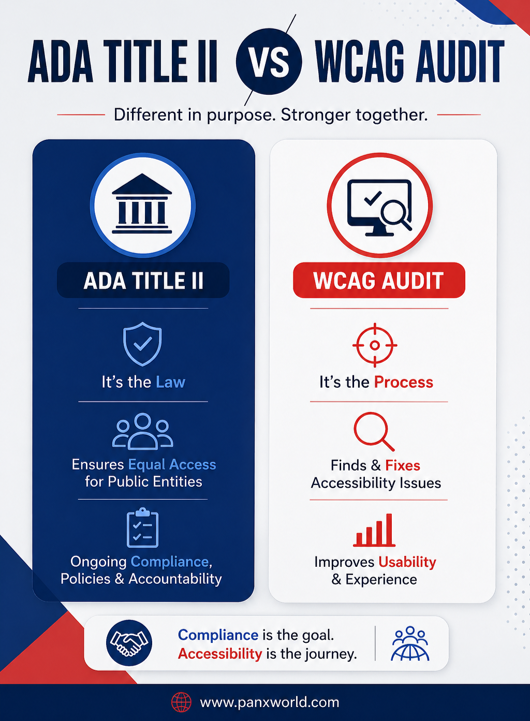
Two Laws, Two Deadlines
A key challenge for public entities is navigating overlapping regulations.
- ADA Title II: Deadline extended to 2027
- Section 504 (HHS): Deadline remains May 11, 2026
While both require WCAG 2.1 AA compliance, they operate under different enforcement frameworks and timelines.
This means organizations cannot rely on the DOJ extension if they are also subject to Section 504.
Why This Matters Now
The DOJ deadline extension may create a false sense of flexibility.
However, for organizations receiving HHS funding, the compliance expectation is immediate.
- Accessibility is already a legal requirement
- Digital barriers can lead to complaints and enforcement actions
- Remediation takes time, especially for large or complex systems
Waiting is no longer a viable strategy.
What Organizations Should Do Next
- Conduct a comprehensive accessibility audit
- Identify high-impact user barriers across digital services
- Prioritize remediation aligned with WCAG 2.1 AA
- Establish internal accessibility processes and accountability
Organizations that act now will be better positioned to meet both Section 504 and ADA Title II requirements.
Conclusion
The DOJ deadline moved. The HHS deadline did not.
For public entities receiving federal health-related funding, May 11, 2026 remains a critical milestone.
Accessibility is not just about compliance timelines — it is about ensuring equal access to essential services for everyone.