What Does WCAG 3 Say? A Look at the Next Generation of Accessibility
Date Published: Sep 15, 2026
Date Modified: Sep 15, 2026
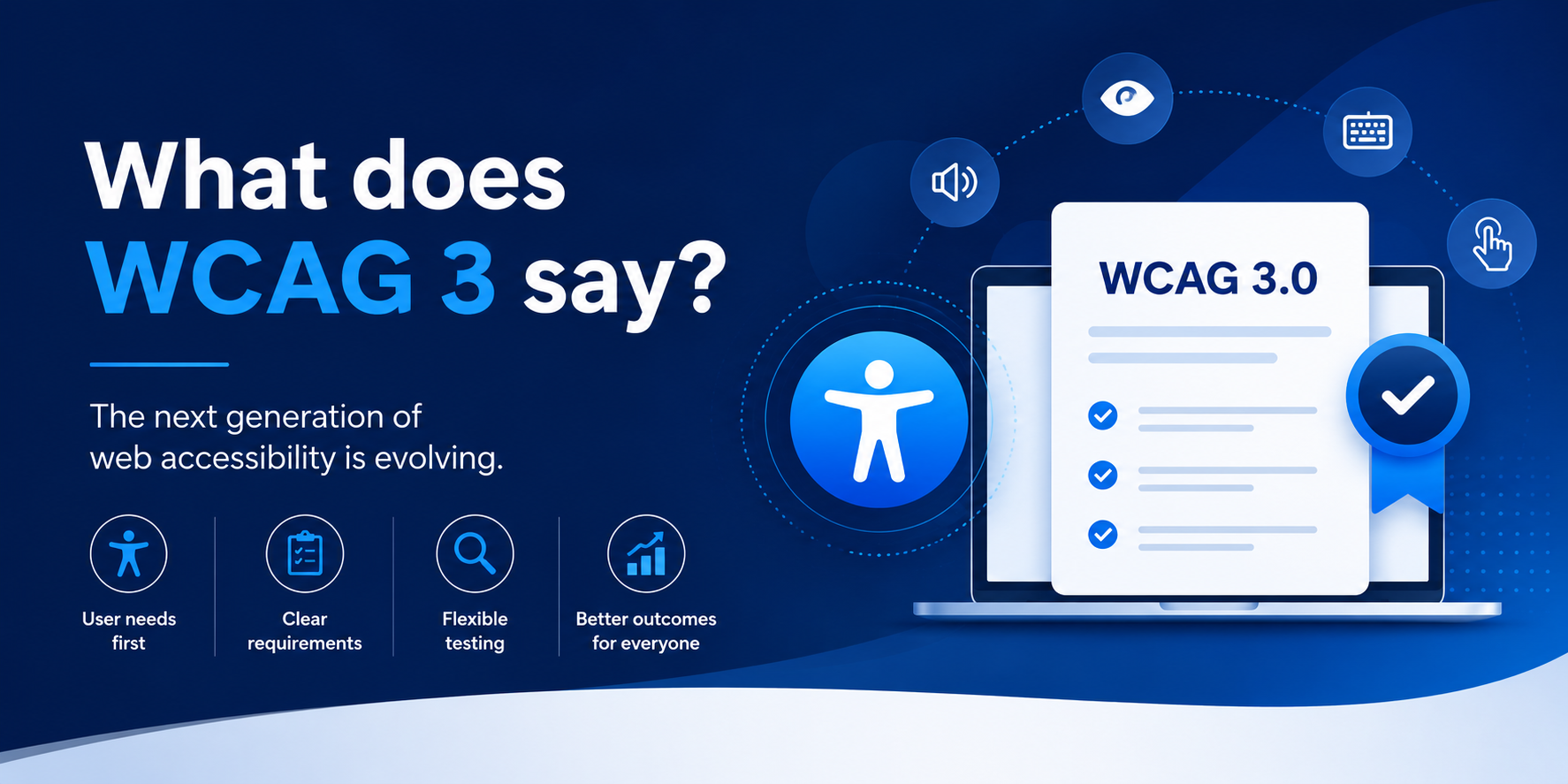
WCAG 3 is shaping up to be a new way of thinking about digital accessibility. Rather than simply adding more requirements to the existing WCAG framework, the next generation of accessibility guidance puts greater focus on user needs, outcomes, flexible testing and the overall accessibility of digital experiences.
But there is an important point to remember: WCAG 3 is still under development. It is a Working Draft, so its structure, requirements and conformance approach may continue to change.
WCAG 3 Is Not Simply WCAG 2.3
WCAG 3 is being developed as the successor to WCAG 2.2, but it takes a different approach to organizing accessibility guidance. Instead of simply adding new Success Criteria to the existing framework, WCAG 3 introduces concepts such as Guidelines, Requirements, Methods and Assertions.
The goal is to make accessibility guidance more flexible and better suited to different technologies and digital experiences.
A Stronger Focus on User Needs
One of the important ideas behind WCAG 3 is a stronger focus on people and their accessibility needs.
Accessibility is not just about whether a technical requirement has passed. It is also about whether people can successfully use and understand a digital experience.
This user-centered approach can help accessibility teams, designers, developers and business leaders connect technical accessibility work with real user outcomes.
Guidelines, Requirements and Methods
WCAG 3 separates accessibility guidance into different layers. This makes it possible to describe the desired outcome, the requirement that supports it and the practical ways of achieving it.
-
Guidelines:
Guidelines describe broad, user-centered accessibility outcomes. They focus on what should be achieved rather than simply providing a technical checklist.
-
Requirements:
Requirements provide more specific expectations that can be evaluated. WCAG 3 currently describes Foundational Requirements and Supplemental Requirements.
-
Methods:
Methods explain practical ways to meet a requirement. They can include technology-specific techniques, examples and testing approaches.
In simple terms, the structure can be viewed as: User Need → Guideline → Requirement → Method → Test.
What Are Assertions?
Assertions are another important concept being explored in WCAG 3.
An assertion is a documented statement about accessibility-related procedures or practices that an organization has followed.
Examples may include:
- Accessibility training for teams
- Accessibility testing processes
- Usability testing
- Assistive technology testing
- Accessibility roles and responsibilities
- Accessibility documentation and processes
Assertions can support an organization's accessibility story, but they are not intended to replace the foundational accessibility requirements.
Testing Is Becoming More Flexible
WCAG 3 recognizes that accessibility cannot always be evaluated through simple automated checks.
The current draft describes both quantifiable and qualitative testing.
- Quantifiable testing: Tests where different testers should generally reach the same result, such as checking whether a specific property or threshold has been met.
- Qualitative testing: Tests that require human evaluation and professional judgment, such as determining whether alternative text provides an appropriate description in context.
This reinforces something accessibility professionals already know: automated testing is valuable, but it cannot tell the whole accessibility story.
Task Flows Matter
WCAG 3 also places greater emphasis on how users complete activities across a digital experience.
A website or application may have individual pages that appear accessible while the complete user journey still contains barriers.
Example: Consider an online shopping journey:
Search → Product Selection → Add to Cart → Checkout → Payment → Confirmation
Testing only one page may miss an accessibility barrier that prevents a user from completing the entire task.
WCAG 3 therefore considers task flows and meaningful user activities as part of evaluating accessibility.
What Happens to A, AA and AAA?
WCAG 2 uses the familiar conformance levels A, AA and AAA. WCAG 3 is exploring a different approach to conformance and reporting.
The current work explores concepts including Foundational Requirements, Supplemental Requirements and Assertions. It also explores reporting concepts such as Bronze, Silver and Gold.
These concepts are still being developed, so organizations should not treat the current model as a finalized replacement for WCAG 2 conformance levels.
WCAG 3 Goes Beyond Traditional Websites
Digital experiences are no longer limited to traditional desktop websites. WCAG 3 is being designed with a broader technology landscape in mind.
- Websites and web applications
- Mobile experiences
- Streaming content
- Wearable technologies
- Virtual reality
- Augmented reality
- Other emerging digital experiences
This broader scope reflects the changing way people interact with technology and the need for accessibility guidance that can evolve alongside it.
Should Businesses Start Preparing for WCAG 3?
Yes, but there is no need to wait for WCAG 3.
WCAG 3 is still a Working Draft, while WCAG 2.2 continues to provide applicable accessibility requirements for organizations today.
Organizations can start preparing by building stronger accessibility practices around:
- Automated accessibility testing
- Manual accessibility testing
- Keyboard testing
- Screen reader and assistive technology testing
- End-to-end task-flow testing
- Accessibility training
- Accessibility governance
- Continuous monitoring and remediation
These practices help organizations move beyond fixing individual accessibility issues and toward building accessibility into the product lifecycle.
Conclusion
WCAG 3 is pointing toward a more user-centered and flexible approach to digital accessibility. It puts greater emphasis on user needs, outcomes, task flows, different types of testing and organizational accessibility practices.
But WCAG 3 is still evolving. Its requirements and conformance model may change before the final standard is published.
For organizations, the best approach is simple: build accessibility today, follow applicable WCAG 2.2 requirements and keep preparing for where accessibility standards are heading.
The future of accessibility is not just about checking more boxes. It is about creating digital experiences that work better for more people, across more technologies and throughout the complete user journey.
Refernce Links: